
Discover Tamebi in Word: Your AI Assistant Inside Your Documents
Every time you use an AI agent inside Word today, your document leaves your laptop. Your contracts, your letters, your reports, your client proposals — uploaded to servers you don't own, processed by models you can't see, kept for who-knows-how-long. Tamebi in Word is our answer to that: open source models (Qwen, GLM, DeepSeek and more) running directly on your laptop or a server, called via slash commands or prompts. No cloud round-trip. No data leak. Just AI that finally respects the file it's working on.
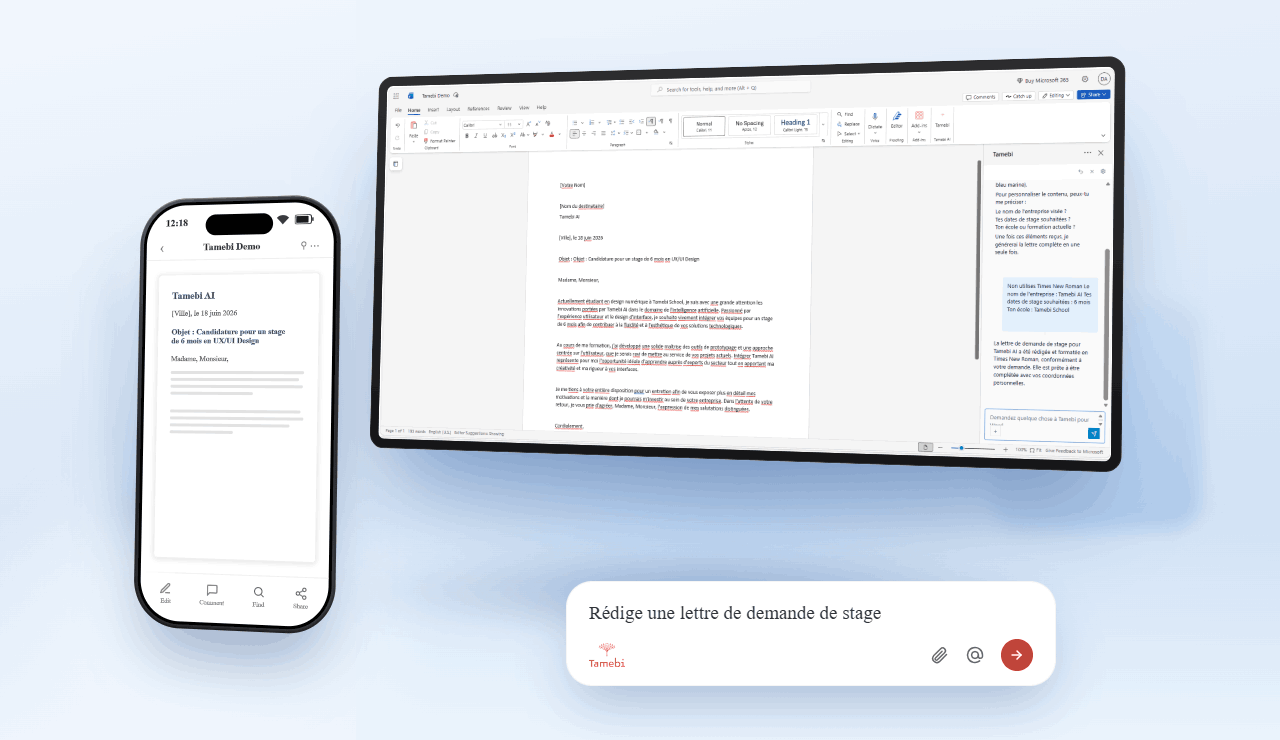
There is a silent trade-off that plays out every time someone types a prompt into an AI feature in Word.
The result is impressive. The friction disappears. But somewhere between the moment you hit Enter and the moment the text appears, your document has left your computer. It traveled across the internet to a server you don't own, was read by a model you can't audit, and was logged in a way you'll never fully see.
For a grocery list, that's fine. For a contract still under negotiation, a named letter of recommendation, a medical report, an employee's HR file, or a commercial proposal that reveals your pricing, it isn't. It's a leak waiting for an incident report.
Tamebi in Word is our answer to that.
What is Tamebi in Word?
Tamebi in Word is a Word add-in that embeds open-source AI models, Qwen, GLM, DeepSeek and others, directly into your documents. Every token of inference happens on your laptop or server. Your files never leave the machine it's already on.
Think of it as the difference between sending your document to "the cloud AI" and asking an AI that lives inside your computer to write and lay it out right there, in front of you.
There's a gap between wanting to use open-source AI and actually using it. In Word that gap is even wider, because the people who spend their days writing (lawyers, HR, executives, program officers, researchers) are also the least likely to spin up a local inference server from the command line.
So we put the server inside the add-in, and the models one click away.
The problem we kept hearing
Before we built this, we kept hearing the same thing, phrased differently, from very different teams:
"I can't paste this contract into a chat, it's still confidential and names real parties."
"Our security team blocked the cloud AI features. We need a local option."
"I have to write a recommendation letter with the person's real name and history, I'm not allowed to upload that."
"I just want to proofread and polish this report without sending it to a US server."
These aren't paranoid worries. They are the daily reality of anyone who writes sensitive documents, which, if you really think about it, is almost everyone who opens Word at work.
The current answer from most AI-in-Word products is some variant of "trust us." Ours is simpler: the data doesn't move.
How it works: slash commands or prompts
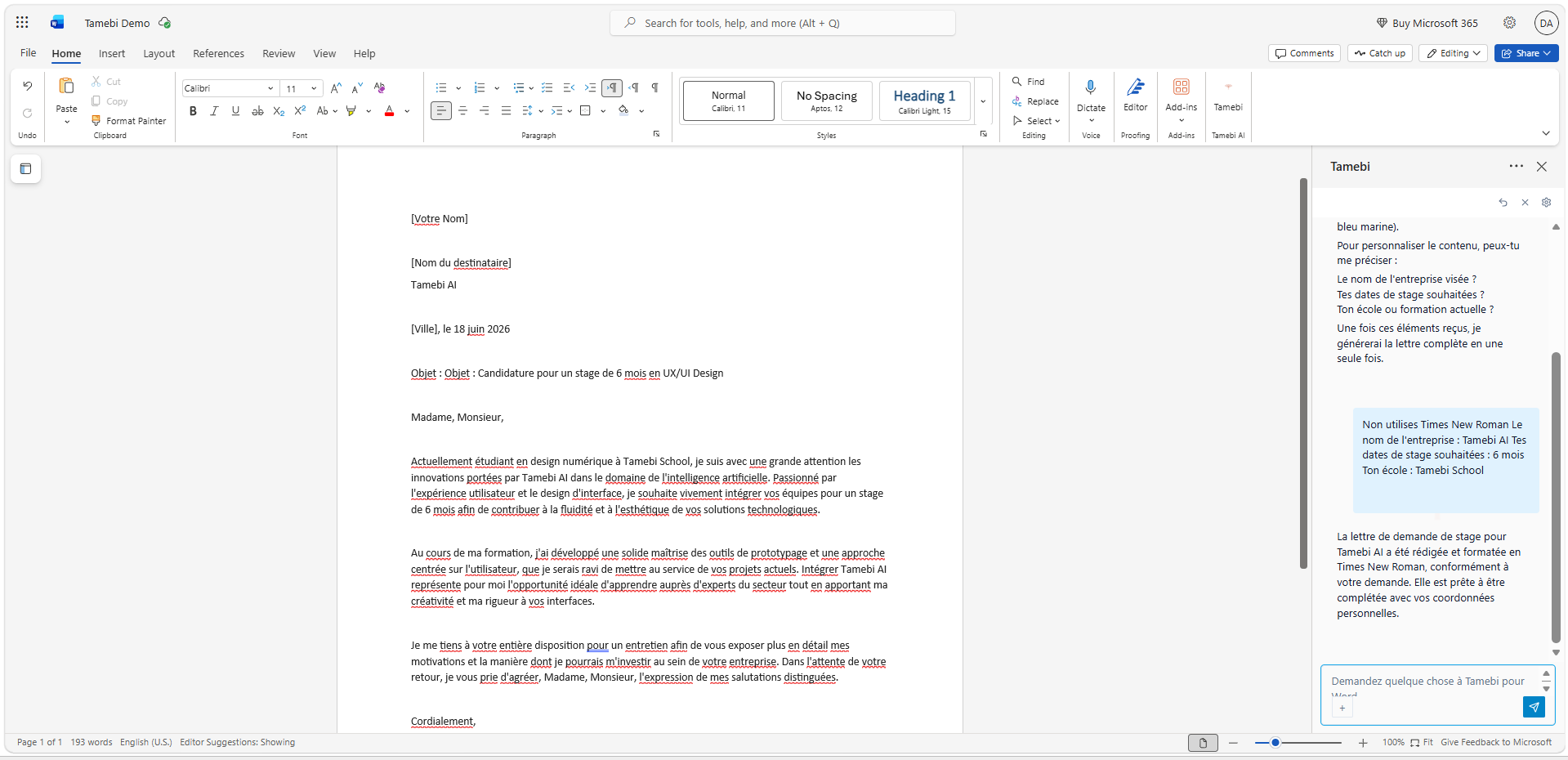
Tamebi in Word lives in an Office pane, but you mostly drive it like a chat: you describe what you want to write, fix, or format, and it acts directly in your document, with a real heading hierarchy, clean styles, and a coherent design.
You type a slash in the pane's chat, you give your instructions, and the document transforms. Here are a few examples of commands currently available in Tamebi in Word:
/rediger: Write a professional section
/corriger: Fix grammar, style, and typography
/resume: A structured executive summary
/rapport: A full report structure, with a table of contents
/lettre: A formal professional letter
/cv: A laid-out professional CV / résumé
/recommandation: A letter of recommendation
/invitation: An event invitation or announcement
/minutes: Meeting minutes
/proposition: A complete commercial proposal
/contrat: A legal contract template
/sop: A standard operating procedure (SOP)
/whitepaper: A whitepaper or academic article
/tableau: Insert a structured table
/style: Professional formatting (native Word styles)
/theme: Apply the Tamebi design system (palettes and fonts)
/polir: A final polish (style, tone, structure)
/traduire: Translate to French or English
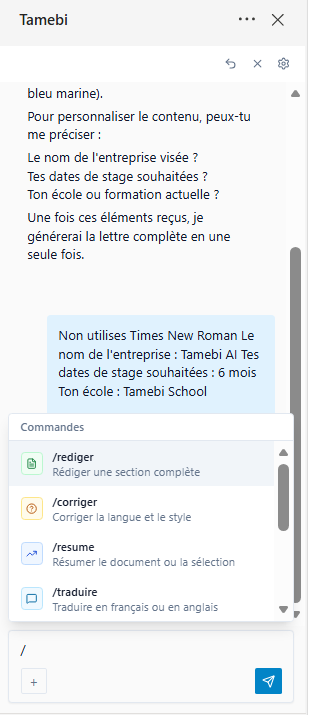
One detail that changes everything: Tamebi doesn't just write text, it lays it out. It promotes headings to real Word styles (Title, Heading 1/2/3), applies a coherent design system (palettes, fonts, spacing), and inserts cover pages, executive summaries, callouts, and formatted tables. The result isn't a wall of raw text: it's a finished document.
The models: Qwen, GLM, DeepSeek and many more
The clear message we want to land is this: Tamebi AI lets you use open-source models (Qwen, GLM, DeepSeek) and others, directly inside Word.
This matters for three reasons.
First, choice. Different models excel at different things. Qwen is excellent for multilingual work and structured extraction. GLM is strong at reasoning and instruction-following, which matters when you ask it to respect a precise document structure. DeepSeek punches well above its class on code, math, and long-context summarization. Inside the add-in, you pick the model from a dropdown, the way you'd pick a font.
Second, transparency. Open-source models can be inspected, fine-tuned, and audited. You can actually know what's running on your machine. That's something no proprietary cloud model can offer you.
Third, sovereignty. The same models that power our add-in run everywhere. If tomorrow you want to move from your laptop to a private server in your own data center, the model doesn't change. There is simply no proprietary lock-in.
Local-first, by design
We want to be very precise about this, because it's the whole point.
When you run a slash command in Tamebi in Word, the model loads on your machine, reads the paragraphs you pointed it at, generates the text and formatting on your machine, and writes the result straight into your document. At no point in that flow does your document touch our servers, the model provider's servers, or anyone else's.
That means:
You can use it on a plane with no Wi-Fi.
You can use it in a disconnected, air-gapped enterprise environment.
You can use it on a document your compliance team would never let you paste into a chat window.
And so nothing slips past you, every write into your document goes through an approval step: you see what the AI is about to do before it does it. If your IT team wants to verify it, they can. The model files are on disk. The traffic is observable. There is no hidden round-trip.
Easy setup: one click, then you're working.
Book your demo with us through this link: https://lab.tamebi.ai/book-demo
Who is it for?
Legal and contracts teams drafting contracts, NDAs, and named legal documents.
HR and people-ops teams producing letters, reviews, recommendations, and employee files.
Executives and consultants writing confidential reports, proposals, and decision memos.
Researchers, healthcare, legal, and public-sector teams subject to data-residency rules.
Small businesses that can't afford an enterprise AI plan per seat.
Anyone in a country where cross-border data transfer is a legal grey area.
And, let's be honest: anyone who has ever hesitated before pasting a confidential document into a chatbot.
What's next?
This is first version (v1). Upcoming releases will add more slash commands, more models, additional themes and templates, batch operations across entire documents, and tighter integration with the rest of the Tamebi ecosystem.
Open-source AI shouldn't stop at the terminal. It belongs everywhere real work gets done. And for hundreds of millions of people, the real work gets written in a document.